Art by Matthew Fleming.
This episode was written & produced by Casey Emmerling.
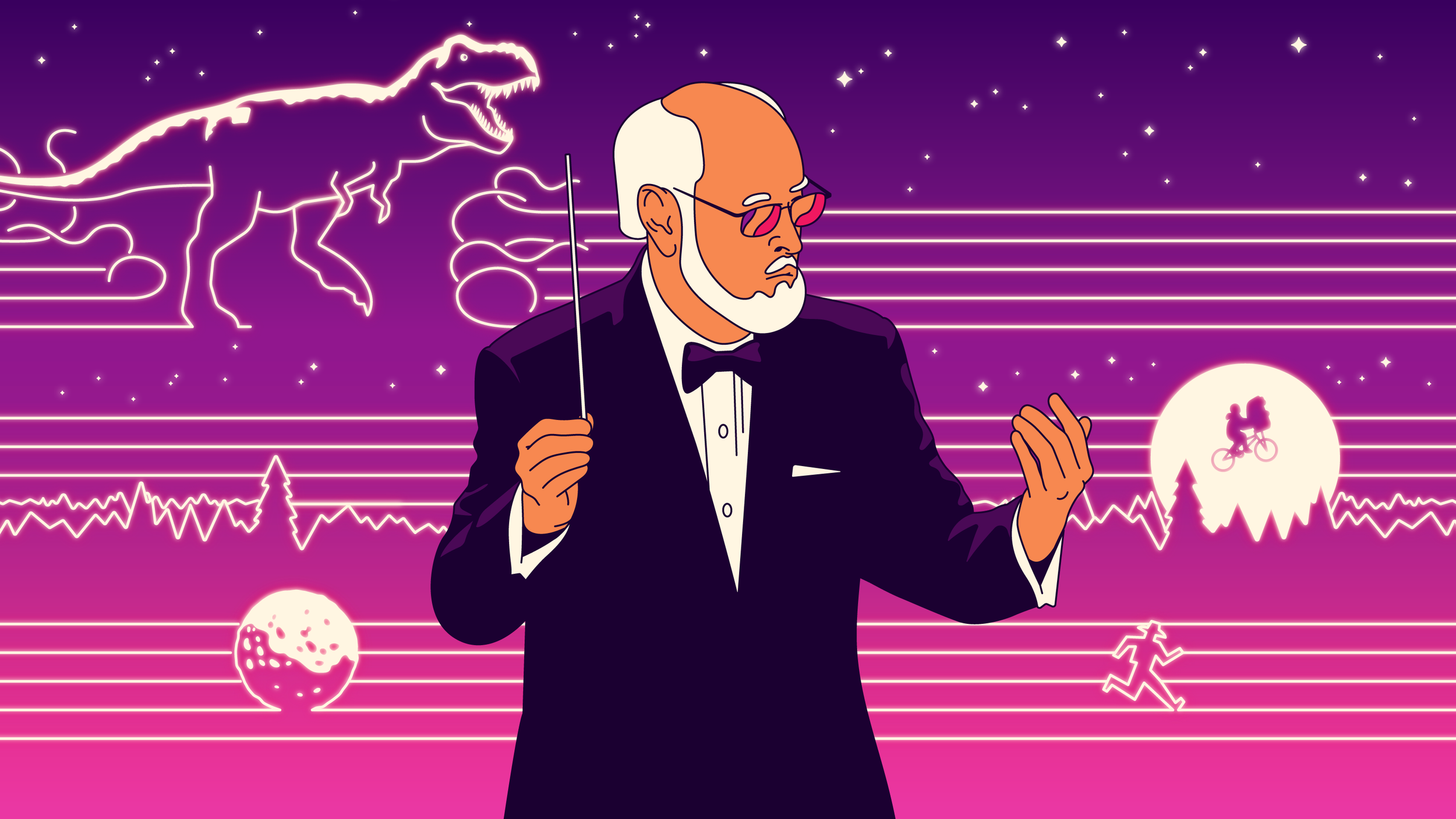
In our last episode, we followed composer John Williams from his childhood to his 1970s run with Steven Spielberg and George Lucas. Now, we pick up the story as John enters an era of seemingly impossible success… from Raiders of the Lost Ark to Home Alone, Jurassic Park, Schindler’s List, and beyond. In this episode, we explore how John revived the grand orchestral score, conquered the classical music world, and crafted melodies that millions of people can instantly recognize. Along the way, journalist Tim Greiving reveals the habits, quirks, and creative brilliance of this living legend.
MUSIC FEATURED IN THIS EPISODE
Brightarm Orchestra - Ready to March
Jo Wandrini - Gates of Olympus
Guto Lucena - Glimpse of a Bird
Trevor Kowalski - With the Herd
Kikoru - Thoughts Revoked
Arthur Benson - The Neighbor's Doghouse
Chronos - Warrior's Journey
Eden Avery - Montage of a Map
Arthur Benson - Dance Hall Days
Franz Gordon - Cozy Day
Franz Gordon - Bohemian Fairy
Jo Wandrini - The Sky Remembers Us
Twenty Thousand Hertz is produced by Defacto Sound.
Subscribe on YouTube to see our video series.
Follow Dallas on Instagram, TikTok, Facebook, and LinkedIn.
Support the show and get ad-free episodes at 20k.org/plus.
If you know what this week's mystery sound is, tell us at mystery.20k.org.
Buy the biography John Williams: A Composer’s Life wherever you get your books.
Subscribe to Tim’s Substack Behind the Moon, an exclusive dive behind the scenes of the book.
Find out how you can get the iPhone 17 Pro at no cost with an eligible trade in at att.com/iphone, or by visiting an AT&T store.
Visit quo.com/20k for 20% of your first 6 months of business phone software.
Sign up for a one-dollar-per-month Shopify trial at shopify.com/20k.
View Transcript ▶︎
[20K sonic logo]
[music in: Brightarm Orchestra - Ready to March]
In our last episode, we explored the early life and career of legendary film composer John Williams. John got his start as a session piano player, recording with orchestras and pop singers… and then started composing for film and TV. In the early 70s, he teamed up with a young Steven Spielberg and scored two of his early blockbusters, Jaws and Close Encounters of the Third Kind. Through Spielberg, John met George Lucas, and created the iconic music for Star Wars.
[music fade under]
By the end of the 1970s, John was the hottest composer in Hollywood, scoring huge films like the 1978 Superman movie.
[Superman up, then under]
The star of Superman, the late Christopher Reeve, loved John's music, and even showed up for the recording sessions. In the liner notes for a Superman music compilation, John said quote, "He was kind of a fan. He would sit next to the podium, or sit in the recording room. And also later films that I did, Chris would come around, sometimes even unannounced, and just sit and enjoy listening to the orchestra."
In 1979, John was back with his friend, Steven Spielberg. And after two consecutive hits...
Tim: Spielberg is on top of the world.
That's Tim Greiving, author of John Williams: A Composer's Life.
[music sneaks in: 1941 - Sub Commander]
Tim: He gets his proverbial blank check to make his next movie, which is 1941, which is a, in my opinion, horrible whiff of something attempting to be a comedy, set during World War II. It's a great score…
[1941 up, then under]
But as for the film itself... Well, if you've never heard of Steven Spielberg's 1941, there's probably a reason for that. Here's Roger Ebert's take.
Roger Ebert: With all his huge box office successes, even Steven Spielberg is human, and even Spielberg can make a stinker, and the big stinker of his career was a 1979 movie named 1941, a critical and box office disaster that was supposed to be a nonstop slapstick comedy, but only really qualified in the nonstop department.
[music in: Jo Wandrini - Gates of Olympus]
Tim: So it's coming off that that he makes Raiders of Lost Ark, which he does to kind of prove himself, and to prove that he can make a film on budget and on time, that works, that's tight, that's fun.
The character of Indiana Jones was created by George Lucas, and inspired by the action serials of the 1930s. George imagined him as an adventurer slash archeologist, who would explore exotic locations and fight evil villains. Spielberg loved the idea, and the two of them developed the movie together.
[music fade out]
Here's Lucas giving a toast to John Williams at an AFI awards ceremony.
George Lucas: Steve and I sat on the beach to talk about the story for Indy. And instantly, we both said at the same time, "John has to write the music." Steve said, "Great. That's the most important part. Let's go have lunch, and we can write the story later." [laughter and applause]
[music in: Raiders of the Lost Ark - Raider's March]
Tim: On Raiders, John had two possible themes. And he played both of them for Spielberg, and Spielberg just said, "Can't we just use 'em both?" So the Raiders March, which has kind of two parts, if you think about it, is the two alternate ideas that he demoed for Spielberg, which I like.
This first melody is one idea...
[music up, then under]
Shortly after, we hear the second one.
[music up, then under]
Now, Indy isn't a soldier, so it's interesting that John composed a military style march for the character.
Tim: If you think about, it's like, why does Indiana Jones have a march?
[music fade out]
Tim: I think what John Williams was tapping into was this nostalgia we have for past adventures. Like when we hear a march, it reminds us of something you might hear at a 4th of July parade.
[music sneaks in: Hogan's Heroes - Closing Theme]
George Lucas jokingly compared the Raiders music to Hogan's Heroes, a '60s sitcom set during World War II. Here's that show's credits theme.
[Hogan's Heroes up, then under]
Tim: There's just something kind of, subtly comforting and throwback about the sound of a march and a marching band that fit with that character and with that adventure.
[Raiders of the Lost Ark - Raiders Theme up, then under]
[music in: Guto Lucena - Glimpse of a Bird]
The early eighties were a whirlwind for John. He married his second wife, Samantha Winslow, who he met through some of the work he did for a PBS station. And he had back to back hits with The Empire Strikes Back and Raiders of the Lost Ark.
Tim: He's just sort of on fire as a composer and working with directors who are giving him these amazing canvases.
On top of all that...
Tim: An interesting and important thing that happens in 1980 is he becomes the conductor of the Boston Pops.
The Boston Pops is an offshoot of the world-renowned Boston Symphony Orchestra.
Tim: …which was kind of an unusual zigzag for him. It wasn't really common for a busy, successful film composer to go conduct an orchestra. But he kind of wanted to prove that he could do more than just score films. He wanted to have more time with an orchestra that he basically could develop as a composer and a conductor with his own group.
[music slowly fades out]
Tim: But it also put him kind of on a national television level. He was already famous because of the scores, but now he was on PBS conducting an orchestra.
[clip: Boston Pops broadcast]
PBS: From Symphony Hall in Boston, John Williams, the Boston Pops Orchestra, and special guest Sammy Davis Jr., tonight for an evening at Pops.
Tim: One of the important things about that is that film music had never really been taken seriously in concert halls before. It was seen as a kinda second-class sellout kind of music among a lot of classical folks.
Tim: But slowly but surely, John Williams starts programming the best of film music in these concerts, and just getting audiences and culture used to hearing this music in concert, and taking it seriously, and recognizing that the best film music is just great music.
[music sneaks in: Boston Pops - Casablanca - Tara's Theme]
Under John's direction, the Boston Pops played pieces by all kinds of film composers... from John's heroes, like Max Steiner...
[Casablanca up, then under]
to his peers, like Jerry Goldsmith...
[clip: Boston Pops - Star Trek Motion Picture - Main Theme]
to... himself.
[clip: Star Wars - Binary Sunset]
Tim: So, throughout the 80s and into the early 90s, he was doing that. And he took the Pops on tour throughout the country, he took them on tour to Japan. It was a really important part of his life every summer and every Christmas conducting all these concerts in Boston.
[Boston Pops Christmas broadcast up, then out]
PBS: Tonight, John Williams and the Boston Pops orchestra invite you to a Christmas at Pops.
But conducting an orchestra didn't slow down John's work as a film composer. And in 1982, he scored Spielberg's next movie, E.T. the Extra-Terrestrial.
[music in: Trevor Kowalski - With the Herd]
In the film's most famous scene, a group of kids are riding bicycles, with ET in a basket... and being chased by the authorities. Then, ET uses some alien magic to make the bikes fly into the air, so they can escape.
John wrote a long, dynamic piece to score that section. But when it came time to record it with the orchestra, he had a hard time matching it to the picture edit. Here's John in an interview with conductor Stéphane Denève.
John Williams: I was trying over and over again, it's a long sequence, about 10 minutes, and every bar has something… something to match here. And if it doesn't match on the screen, it doesn't have its effect. It doesn't really look right. And I made, I don't know how many takes, how many performances, attempts to do this. I couldn't get it right.
So Steven Spielberg stepped in, saying...
John Williams: "John, just play the music. I know it fits. It has exactly the silhouette of the action. You have the orchestra play it, what's comfortable, and I will recut the film to the orchestral performance," which he did.
[music fade out]
This is a pretty rare move. In filmmaking, the music almost always follows the picture edit, not the other way around. And it's a testament to how much Spielberg trusted John. Here's a clip of how the scene turned out.
[ET scene begins]
The kids are trying to get away on their bikes.
There's a roadblock. They're about to be caught.
And then... liftoff.
[scene up, then under]
John Williams: And I have a feeling that something about the end of that movie, which is so moving, I have to think that some of that emotion that we get is because the orchestra was allowed to play without any inhibition.
John later told Stephen Colbert that of all the scores he'd written, ET is probably his favorite. He explained how the main musical theme develops through the story.
John Williams: We will remember the film when the bicycles take off, and… but prior to that, the bicycles, you will hear two or three notes of the theme, and that's all.
[clip: ET - Far From Home]
John Williams: And the next time you may hear three or four notes.
[clip: ET - Toys]
John Williams: And it's beginning to form in your memory as we're going along with the thing.
[clip: ET - Sending the Signal]
John Williams: And as the bicycles take off, you hear all 12 of the notes, and the melody is realized, and finished.
[clip: ET - Escape/Chase/Saying Goodbye]
John Williams: I like to believe that the audience has a sense of completion, and something has been made, aurally, that is created and aimed at that very moment.
[ET up, then under]
As the 80s went on, John scored his third Star Wars film, two Indiana Jones sequels, and many others. He also wrote two themes for the Olympics. One for the Los Angeles games in 1984...
[clip: Olympic Fanfare and Theme]
And one for the Seoul games in 1988.
[clip: The Olympic Spirit]
Then in 1990, John scored a movie about a boy who accidentally gets left behind on Christmas... Home Alone. It was John's first chance to write Christmas music. And after watching the rough cut, he wanted to score these comedic hijinks like a ballet.
[music in: Home Alone - Holiday Flight]
For the chaotic scene where Kevin's family realize they overslept, John borrowed from Tchaikovsky's Christmas ballet, The Nutcracker. This music is from Home Alone.
[Home Alone up, then under]
And here's The Russian Dance, from The Nutcracker.
[transition smoothly into Tchaikovsky - The Nutcracker - Russian Dance]
[music sneaks in: Home Alone - Somewhere In My Memory]
For the title theme, John wrote a legit Christmas carol that's since become a holiday classic. The lyrics were written by British songwriter Leslie Bricusse, who also co-wrote the songs for Charlie and the Chocolate Factory. It's called Somewhere In My Memory.
[Home Alone up, then under]
As John told Variety...
John Williams: I think Home Alone is very special. It's a timeless piece. Ages very, very well. Very rewarding and very satisfying.
[Home Alone out]
The same year that Home Alone came out, sci fi author Michael Crichton published a novel about scientists bringing dinosaurs back to life. It was called Jurassic Park. Several directors tried to get the movie rights to the story, including James Cameron, Tim Burton, and Joe Dante. But Crichton wanted Spielberg to adapt his book, and Spielberg agreed. And as usual, he asked John Williams to score it.
Tim: The interesting thing about the approach to Jurassic Park's score is you would think that it would just be scored like a straight up monster movie, a creature movie.
[music in: The Beast from 20,000 Fathoms]
For example, here's the theme from a 1950s dinosaur movie called The Beast from 20,000 Fathoms.
[The Beast from 20,000 Fathoms up, then out]
Tim: But John Williams, being the genius that he is, recognizes that there's something kind of religious about the way the scientists feel about seeing dinosaurs come back to life. They're in awe.
Here's Steven Spielberg in an interview with Deadline.
Steven Spielberg: John talked about the nobility of these animals. We never called them "monsters." We never called them "dinosaurs." We called them "animals." John scored this movie with the heart of a child that knew how to create a sense of wonder about these amazing, magnificent animals.
[music sneaks in: Jurassic Park - Main Theme]
Tim: And so the theme for Jurassic Park, there's multiple themes, but there's a theme for it that is this kind of serene hymn-like melody that is tapping into the awe and wonder and almost kind of religious grandeur of the way these characters feel.
[Jurassic Park up, then under]
Tim: People have walked down the aisle to the Jurassic Park theme, which, on its face, seems ridiculous, but if you hear the music, it's perfect for a wedding.
[music transition into: Jurassic Park - Eye to Eye]
Tim: And obviously there's action and terror and stuff in that score, too.
[Jurassic Park up, then out]
But Jurassic Park wasn't the only Spielberg/Williams collaboration from that year.
Tim: Steven Spielberg couldn't attend the scoring sessions for that because he was already in Poland shooting Schindler's List. So it was kind of an unusual timing thing where they couldn't be together. They saw the film together, and then John Williams was on his own to do his thing. At that point, Spielberg trusted him so implicitly that he knew he'd do a great job.
Tim: And they would send cassettes over to Poland for Spielberg to listen to on his way to and from set shooting Schindler's List. So it's a really strange juxtaposition of this like escapist, fun, popcorn, dinosaur movie, while Spielberg is in the cold, making this harrowing Holocaust drama.
Schindler's List is based on the true story of Oskar Schindler, a German member of the Nazi party. During the Holocaust, he helped save over twelve hundred Jews by employing them in his factories.
As John told Deadline, when Spielberg showed him the rough cut, John was so moved that he couldn't speak. So he went outside for a few minutes to get some air.
John Williams: And I went outside and I walked around for four or five minutes, and came back in to start our meeting. And I said to him, "Steven, this is a great, great film, and you need a better composer than I am to do this score." And he said, "I know, but they're all dead." [laughter]
Tim: Schindler's List was a tricky challenge because they're dealing with real history and some of the most, like, daunting, sobering history of the 20th century. And so they felt this real burden and responsibility to do it right.
Tim: And part of the idea with Schindler's List was, "Let's not over-score it. Let's leave a lot of it clean and, and without any music at all." The whole visual approach to that was "make it feel like a documentary almost." It's in black and white. There's not a lot of fancy crane shots or anything like that. So the music had to sort of honor that same approach of austere and respectful.
[music sneaks in: Schindler's List - Main Theme]
Tim: But the thing that John Williams keyed into was, the score should not be about the tragedy and the brutality for the most part, it should be about the humanity of these people. And he came up with this theme that's like a Jewish lullaby, basically.
[Schindler's List up, then under]
Tim: And it's a sad piece, but really a piece about something you might hear as a child, and the comfort that that brings, and just emphasizes the souls and the humanity of these characters.
[Schindler's List up, then under]
Schindler's List earned John his fifth Academy Award, following Fiddler on the Roof, Jaws, Star Wars, and ET. In his acceptance speech, John thanked his music editor, the Boston Symphony Orchestra, and ended with...
John Williams: And for a man who always makes work fun and is a seeming unending source of inspiration, Steven Spielberg. Thank you. [applause]
[music in: Kikoru - Thoughts Revoked]
By this point, John was more than thirty five years into his film composing career, and he wasn't slowing down.
Soon enough, he'd score one of the most iconic war movies of all time.
Steven Spielberg: This is one of the most requested scores throughout our entire United States military.
And he'd reinvent the music of Star Wars with an epic choral theme.
George Lucas: It's a wonderful piece of music with the choir, and it's very operatic, and very much like Star Wars.
That's coming up, after the break.
[music out]
MIDROLL
[music in: Kikoru - Thoughts Revoked]
By the late nineties, John Williams had already had an astonishing career. With hit movie after hit movie, he had helped bring big, sweeping film scores back into the mainstream.
Tim: It was not inevitable that John Williams would be able to do the kind of scoring that he did. The old fashioned orchestral, melodic, operatic kind of score had gone out of fashion in like the 1950s. So people like Martin Scorsese and other contemporaries of Spielberg and Lucas are not looking to that kind of scoring approach. They're looking to pop music, or something unconventional, or modern.
Tim: So it was because Spielberg and Lucas were these kind of big kids who had this nostalgia for old movies from the '30s and '40s, and had this sort of classical sensibility, that they wanted someone like John Williams to do the kind of scores like Star Wars and Raiders, that it was like lightning in a bottle of the timing of these guys all making movies together at the same time, which then was insanely popular, and made millions of dollars at the box office.
[music out]
By 1998, John Williams and Steven Spielberg had made fifteen films together. And their next collaboration was the World War II epic Saving Private Ryan.
Keep in mind, John was born in 1932... And he remembered growing up during World War II. So for him, this story wasn't distant history, and he wanted to do it justice. But he felt that using too much music would take away from the realism. So for many of the battle scenes, they left music out.
Here's John in a behind the scenes featurette.
[Saving Private Ryan scene in]
John Williams: Most of the battle scenes were done in a realistic way. So we had the sound of the tanks and the sound of the guns and all of the… the atmosphere of the struggle.
[Saving Private Ryan scene under]
John Williams: And the music really struck the emotional part of it, and the quieter scenes, really.
[music sneaks in: Saving Private Ryan - Hymn to the Fallen]
The movie's main musical theme is called Hymn to the Fallen, which doesn't play until the end credits.
John Williams: The Hymn to the Fallen was kind of a set piece. You had the sense that we needed a kind of requiem almost for the people lost in the film. And how to do that tastefully, and discreetly, and quietly, and hopefully elegantly, was the opportunity that it presented. And of course, chorus and orchestra is still the best medium for that kind of thing.
[Saving Private Ryan up, then under]
When describing this score to Deadline, Spielberg said...
Steven Spielberg: Musically, it honors all of the veterans, both today and yesterday, and it's why the military is always asking if they could play, perform this score. This is one of the most requested scores throughout our entire United States military.
[music fade under]
A year later, John would lean into this choral sound again. This time, it was for a new Star Wars movie, The Phantom Menace. The film's most famous piece plays during the epic final battle... when Obi Wan and Qui-Gon Jinn fight Darth Maul. It's called Duel of the Fates.
[clip: Phantom Menace - Duel of the Fates]
In Dueling with Fate: The Making of The Phantom Menace, John said:
John Williams: The great sword fight at the end of the film, the decision to make that choral was just the result of my thinking that it should have a kind of ritualistic or quasi-religious feeling to it, if you like, and that the introduction of a chorus might be just the thing.
This was the first time that a chorus had appeared in a Star Wars score. So for this ancient, alien universe... what words should the choir sing? To start, John used a medieval Welsh poem, called The Battle of the Trees. It's about a sorcerer who makes trees come alive, and fight the forces of the otherworld. This poem was likely an inspiration for the Ents in The Lord of the Rings.
[clip: The Two Towers]
Treebeard: Come, my friends. The Ents are going to war.
John took two lines from the poem, and translated them into multiple languages. He picked the ancient language Sanskrit, because he liked the vowel sounds. Next, he rearranged the words by ear, moving syllables around until it felt right. Then, it was just a matter of coaching the choir. Here's John working with them in a scoring session.
John Williams: I've chosen these Sanskrit words because of the quality of the vowels. Do it again please. See how pure a choral sound you can get. Don't force it. So. [choir singing] That's better.
Here's the final version.
[clip: Phantom Menace - Duel of the Fates]
Here's George Lucas describing the piece in that behind-the-scenes documentary.
George Lucas: It's a wonderful piece of music with the choir and it's very operatic, and very much like Star Wars.
[Phantom Menace out]
[music in: Arthur Benson - The Neighbor's Doghouse]
Through the years, John has developed very specific preferences for how he likes to work. For instance, some composers will begin writing music when all they have is a script, or maybe the storyboards. But John doesn't like to start writing until he can see the actual footage. As he told NPR…
John Williams: I, over the years, have always felt more comfortable if I could go into a projection room, look at a film and not really know what to expect. If you read the script first, you form all kinds of preconceptions about how things look, and what the location's like, what the actors are like. And then you may look at what the director's chosen, it doesn't comport with your conceptions at all.
But screening the film lets him experience it like the audience will.
John Williams: If I have the luxury of going into the dark projection room and being surprised when the audience is surprised, and being bored when they're bored, I think that gives me a sense of what my job is, where I can press the accelerator button if I need to, or support an emotion, or don't.
When he does start scoring, he does it the old fashioned way.
Tim: He learned how to score films in the 1950s, which meant you worked with pencil and paper and a stopwatch, and he never really changed. He never was interested in technology. He's never owned a computer. He doesn't own a smartphone.
Tim: He eventually had to have people kind of translate his stuff to Pro Tools and, you know, the digital machinery of modern filmmaking and modern recording. But his actual process is still doing his whole orchestration or some like condensed version of the orchestration on paper.
Tim: He doesn't even really write at the piano. He will just go to the piano sometimes to solve a problem, or to figure something out. But he's actually mostly just writing in his head. And he knows like timings so well that if this needs to happen within a couple of seconds, or this piece needs to last two minutes, he knows in his head, timing of music innately, which is pretty astounding.
[music out]
In the twenty first century, John has stayed very busy. On the franchise side, he's scored two more Indiana Jones films, and five more Star Wars movies... completing the nine-film Skywalker saga.
Tim: John Williams could have left that series at any time, and no one would've blamed him, but he really clung to it. And partly, it was outta loyalty to people like George Lucas. But part of it was that Star Wars was his baby, and he didn't want other people messing around with his themes and with his music. So he just stayed on Star Wars, which again, I think is why Star Wars will kind of define his legacy.
[music in: Force Awakens - Rey's Theme]
The Star Wars sequel trilogy revolves around a new, Force-sensitive character named Rey. And Rey's Theme is probably the most well known piece of music from the new series. Here's John in a featurette called The Sound of a Galaxy.
John Williams: Rey, her theme has a musical grammar that is not heroic in the sense of a hero's theme.
[Force Awakens up, then under]
John Williams: It's kind of an adventure theme that maybe promises more than resolving itself in the most major triumphant resolutions.
[Force Awakens up, then out]
Meanwhile, John has continued working with Steven Spielberg on almost everything that he makes, including Catch Me If You Can...
[clip: Catch Me If You Can - Main Theme]
War of the Worlds...
[clip: War of the Worlds - Escape from the City]
…and Lincoln.
[clip: Lincoln - The People's House]
Tim: Again, he doesn't have anything to prove. He doesn't have to keep working. But he just, he loves composing, he loves challenging himself. He loves to do something he's never done before.
[music in: Chronos - Warrior's Journey]
John has also continued to conduct live orchestras, including annual concerts at the Hollywood Bowl with the Los Angeles Philharmonic. In 2025, the Hollywood Bowl renamed their stage The John Williams Stage.
Tim: And he just kept proving that good film music is really fun to play for musicians, and fun to hear for audiences, and it's great music.
Tim: And within the last five or 10 years, he was even invited to conduct the Berlin and the Vienna Philharmonic and these sort of like historically important symphony orchestras, which just felt like a coronation of a kind of like, he proved the case that film music belongs in these concert halls where great classical music is played, and that even the most snobby, kind of serious, discerning orchestras wanted him to come bring his music into their houses.
In short...
Tim: He conquered Hollywood, and then he sort of conquered the classical world after that.
[music out]
Several years ago, Tim started working on his book about John... which is the first major biography of this iconic, but very private man.
Tim: He was never comfortable with the idea of having a biography, so that was a thing we had to get over. It took me a long time to even get in the door for that.
But eventually, Tim broke through, and John agreed to be interviewed.
[music in: Eden Avery - Montage of a Map]
Tim: It was like a dream come true for me, 'cause I've been obsessed with John Williams since I was nine years old, which is when I heard Jurassic Park for the first time. So to go into his office where he wrote Jurassic Park, and see the piano where he wrote the themes for ET and Jurassic Park on was just like, out-of-body for me.
Tim: And he put me at ease right away. And It was like a sitcom of like a young fan talking to a brilliant artist genius. But we developed a certain kind of rapport that… I looked forward to those days of going into his studio, and I kind of had a captive John Williams that I could just… anything I ever wanted to ask him, I could ask him. It was amazing.
[music out]
Through those sessions, Tim got to know John in a way that probably no other journalist has.
[music in: Arthur Benson - Dance Hall Days]
Tim: John Williams has always seemed like a man out of time, like he's seemed like an old man in a young man's body from the beginning. Yo-Yo Ma kind of described him as "Santa Claus's brother." Someone else talked about him being like this school teacher in a 19th century Vermont schoolhouse.
Tim: He's got this sort of like, mannered, genteel, intelligent, kindly, grandfatherly quality. And he's always had that. And obviously, as he became more of a grandfather type, it fit more. But he's always been like that. He's always been serious about his craft, but not taking himself too seriously. He's a lot funnier than maybe people realize. He's not like a boring hang. He's very fun.
Tim: But his habits are consistent. He eats the same lunch every single day. It's a turkey sandwich with orange soda. He has the same routine. He gets up at the same time. He works for the same amount of hours. He finishes the day by playing a round of golf and then having a drink. He reads music at night. He doesn't listen to it. He just reads it off the paper. He reads books about history, about music history, about all kinds of things. He's maybe the smartest person I've ever met in my life.
[music out]
But it's not just John's routines and habits that are consistent. It's also his working relationships.
Tim: Every person I interviewed confirmed that he's the nicest guy. Everybody loves him, he never loses his temper, and he doesn't have a huge ego, which for someone with his success and his resume, he should have a huge ego, but he doesn't. He's genuinely very humble.
Tim: So one of the challenges of writing a book about him was his life is not full of drama. It's not like he's out there burning bridges in these big fights with people or... you know, he spends most of his life hunched over his scores, or at the piano, or conducting concerts.
Beyond that, he has a wife of almost forty five years, along with three grown children, and multiple grandchildren.
Tim: There's not a lot going on in his personal life beyond those things. It's just, it's all consumed by music. But I, I think it's part of who he is, is that he has such a high standard of excellence for himself that I think is remarkable. But it speaks to why he's been so successful.
[music in: Franz Gordon - Cozy Day]
In 2022, John scored Steven Spielberg's film The Fabelmans, a coming of age story about a boy who falls in love with filmmaking. It's basically a fictionalized version of Spielberg's early life.
Tim: John Williams is 90 when he scores The Fabelmans. A lot of people think it's maybe gonna be his last score. It would be a really fitting final score, because it's basically him scoring the story of his friend's childhood.
Tim: And John Williams knew Spielberg's parents. They would often go to scoring sessions, and so John had some affection for the real Mr. And Mrs. Spielberg.
[music fades under]
Tim: And his theme was, basically a love letter to them, and to Steven Spielberg.
[music in: The Fabelmans - Main Theme]
Tim: And it's a very tender score.
Tim: There's this beautiful main theme that's basically about the mother/son relationship.
Tim: And it sounds again, like a lullaby, or something you could hum, or you'd hear your mother humming when you're a kid.
Tim: And it's beautiful. It's one of the most beautiful themes he's ever written, I think.
[The Fabelmans up, then under]
[music in: Franz Gordon - Bohemian Fairy]
Year after year, with film after film, John has tapped into something that millions of people connect with... creating some of the most iconic and moving moments in cinema history. His scores strike a perfect balance between accessible and intricate... so no matter your age, your background, or your knowledge of music, there's something for everyone to latch onto.
Tim: So much of his music is seeming simplicity on top, and all this complexity underneath the surface, which makes musicians enjoy playing it. It's challenging to play. It's interesting to play. It also makes it something you love as a kid, or you love at first listen, but then you can go deeper and deeper, and just keep exploring the depths of his music.
John could have retired decades ago, and he'd still be one of the greatest composers of all time. But he never stopped. As of this recording, John is ninety four years old, and still scoring movies. His latest film is Disclosure Day, which is his thirtieth collaboration with Steven Spielberg.
Here's John describing their decades-long relationship to CNN.
John Williams: He's a close friend, he is family, and I love him dearly. He's an inspiration, he's a muse. He's also not something, he's not someone you can say no to.
John might jokingly blame it on Spielberg... but leaving music behind just isn't in his DNA.
Tim: I think music is oxygen to him. I think it's what's kept him going, and kept his mind so sharp. And he doesn't want to do anything else. And I've asked him about retirement or whatever, and he just says, "Why would I retire? Why would I stop doing the thing that gives me such pleasure?" And I think as long as his mind and his body allow him, he'll just keep writing music.
In an interview with conductor Stéphane Denève, John summed up his feelings by quoting a famous composer, Sergei Rachmaninoff.
John Williams: Music is so fabulous. I can just give you what is now a cliche, but it's a great quote of Rachmaninoff's who says, finally, that "a lifetime of music is enough for a lifetime. But no lifetime is enough for music." Music is for me our greatest gift.
Credits:
[music out into music in: Jo Wandrini - The Sky Remembers Us]
Twenty Thousand Hertz is produced by my sound agency, Defacto Sound. Hear more at defacto sound dot com, or by following Defacto Sound on Instagram.
Other Voices: This episode was written and produced by Casey Emmerling, with help from Grace East. It was sound designed and mixed by Brandon Pratt and Jade Dickey.
Thanks to our guest, Tim Greiving. Tim's book is called John Williams: A Composer's Life. You can find it wherever books are sold, and there's also a link in the show notes.
Finally, think of someone you know who would really appreciate the story of John Williams. Then, open up part one of this story in your podcast app, tap Share, and send it to them.
You can find me on Youtube, Instagram, and Tiktok under the name dallastaylor dot mp3.
Thanks for listening.
[music out]
View Transcript ▶︎